

COLUMBUS, Ohio (CN) - An attorney permanently disbarred for misconduct while acting as a common pleas court judge can pursue due process claims against the justices of the Ohio Supreme Court, a federal judge ruled Friday.
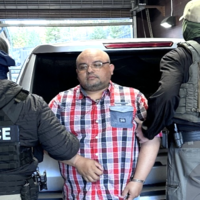
Steven Terry, whose tenure as a Cuyahoga County Common Pleas Court judge began in 2007, was convicted of federal conspiracy and mail fraud charges in 2010 after taking bribes from former Cuyahoga County Auditor Frank Russo.
Terry made judgments in two foreclosure actions at the behest of Russo, who then made donations to Terry's reelection campaign totaling $1,200.
Unbeknownst to Terry, Russo was being investigated by the FBI, which had tapped his phone and recorded conversations about the quid pro quo deal.
The judge in Terry's criminal case sentenced him to 63 months in prison, in part because he found Terry committed perjury during the trial. The Sixth Circuit affirmed his convictions in 2011.
Terry sued the Ohio Supreme Court and its seven justices in federal court in 2024, claiming Ohio's permanent disbarment rule is unconstitutional because it prohibits a disbarred attorney from ever being reinstated to practice law.
U.S. District Judge Algenon Marbley, a Bill Clinton appointee, denied the justices' motion to dismiss Terry's substantive due process and equal protection claims Friday.
The liberty interest underpinning Terry's claims is the ability to chose one's profession, and while Marbley acknowledged courts have not recognized this as an established fundamental right, he emphasized it is still entitled to some protection under the due process clause.
As such, he determined Ohio's disbarment rule must be reasonably related to a legitimate government interest to withstand Terry's claims, a bar it cannot meet.
Marbley cited Sixth Circuit and U.S. Supreme Court case law that supported Terry's contention that an outright prohibition of one's career path is unconstitutional, including the 1957 U.S. Supreme Court case Schware v. Board of Examiners of N.M.
"In Schware, the court held a plaintiff's former membership in the Communist Party and arrest record relating to union activities did not have a rational connection to the plaintiff's fitness or capacity to practice law," he said. "Here, plaintiff has alleged the same: a complete prohibition from the practice of law that has no rational connection to his fitness to practice law."
Marbley also rejected the justices' argument Terry's lawsuit was time-barred by the two-year statute of limitations governing Section 1983 actions, and agreed with the former judge that permanent disbarment represents a "continuing violation" of his due process rights.
"The injury and allegedly unconstitutional act of being permanently disbarred without opportunity to seek reinstatement is continuing to accrue ... and plaintiff Terry has alleged suffering from a new deprivation of constitutional rights every day that the rule is effective," he said.
Terry's initial complaint included examples of other attorneys charged with federal crimes who were indefinitely suspended by the Ohio Supreme Court, a punishment that allows for eventual reinstatement.
He highlighted the case of Bridget McCafferty, another former Cuyahoga County Common Pleas Court judge caught up in the same corruption scandal with Russo who was convicted of making false statements to law enforcement officers.
McCafferty was indefinitely suspended by a split Ohio Supreme Court, and the seemingly inconsistent application of disciplinary procedures when contrasted with Terry's permanent disbarment is sufficient to survive the motion to dismiss, Marbley found.
Friday's ruling did, however, dismiss claims made against the justices in their individual capacities, as well as those brought against the Ohio Supreme Court which cannot be sued under Ohio law.
Terry did not respond to a request for comment. But in an emailed statement, Ohio Attorney General deputy press secretary Dominic Binkley said the state will continue to fight for Terry's disbarment.
"Today's decision just means this case won't be disposed of on the pleadings. We remain committed to defending the order barring former judge Terry from ever practicing law again in Ohio," Binkley said.
Source: Courthouse News Service